
Introduction:
How to Do Keyword Research for SEO and AEO?
One common question that arises is: What tools are best for conducting keyword research for AEO?
What tools are best for conducting keyword research for AEO? Understanding the essentials will help you identify the right resources.
When exploring the question, what tools are best for conducting keyword research for AEO? You will discover various platforms that cater to this need.
If you’ve ever typed something into Google and clicked one of the first few results, you’ve already interacted with SEO – even if you Polished Version (Improved, Not Rewritten)
If you’ve ever typed something into Google and clicked one of the first few results, you’ve already interacted with SEO — even if you didn’t know it at the time.
Search engines like Google and Bing — along with newer AI-powered tools such as ChatGPT, Claude, and Perplexity — are all trying to answer one simple question:
“What is the best possible answer for this user?”
As we delve deeper, we will address what tools are best for conducting keyword research for AEO? This will lead us to effective strategies.
To fully leverage your content, you need to grasp what tools are best for conducting keyword research for AEO? This knowledge is crucial for success.
Keyword research is how we figure out what questions people are actually asking — and how we create content that answers those questions clearly, accurately, and in a way search engines and AI tools understand.
What Is SEO (In Simple Terms)?
SEO stands for Search Engine Optimization.
At its most basic level, SEO means:
Helping search engines understand what your content is about so they can show it to the right people.
Search engines work by:
- Crawling websites
- Reading content
- Matching that content to what users are searching for
Keywords are the bridge between:
- What people type into search engines
- And the content you create on your website
If you use the wrong keywords, even great content can go unseen.
If you use the right ones, your content has a real chance to show up when people actually need it.
This is just the first step to finding out what tools are best for conducting keyword research for AEO?
What Is AEO (And Why It’s Different)?
AEO stands for Answer Engine Optimization.
While SEO focuses on ranking pages in search results, AEO focuses on:
- Answering questions directly
- Appearing in featured snippets
- Powering AI-generated answers
- Showing up in voice search and conversational tools
Instead of asking:
“How do I rank for this keyword?”
AEO asks:
“How do I become the best possible answer to this question?”
This matters because people don’t just search anymore — they ask.
Examples:
- “How do I do keyword research?”
- “What tools are best for SEO beginners?”
- “Can ChatGPT help with SEO?”
AI tools don’t just scan for keywords.
They prioritize clear explanations, structured answers, and strong topical coverage.
That means keyword research today isn’t just about search volume — it’s about intent, questions, and context.
Why Keyword Research Is the Starting Point
To find out “What tools are best for conducting keyword research for AEO? ” we first need to understand.
Before you write:
- A blog post
- A landing page
- An FAQ
- Or even a product description
You need to understand:
- What people are searching for
- How they phrase those searches
- What kind of answer they expect
Keyword research removes guessing.
Instead of thinking:
“I think people might search for this…”
You learn:
“People are already searching for this exact question.”
For beginners, this is powerful — because it gives you clarity and direction from the start.
SEO Keywords vs AEO Keywords (Beginner View)
Traditional SEO keywords often look like:
- “keyword research tools”
- “SEO best practices”
- “on page SEO”
AEO-focused keywords often look like:
- “How do I do keyword research for beginners?”
- “What tools should I use for keyword research?”
- “What’s the difference between SEO and AEO?”
Both matter — but they serve different purposes.
In this guide, you’ll learn how to:
Combine both into one smart strategy
Find traditional keywords that help pages rank
Discover question-based keywords that power AI answers
Knowing the difference between SEO and AEO is essential in understanding what tools are best for conducting keyword research for AEO?
2. Understand Keyword Formats
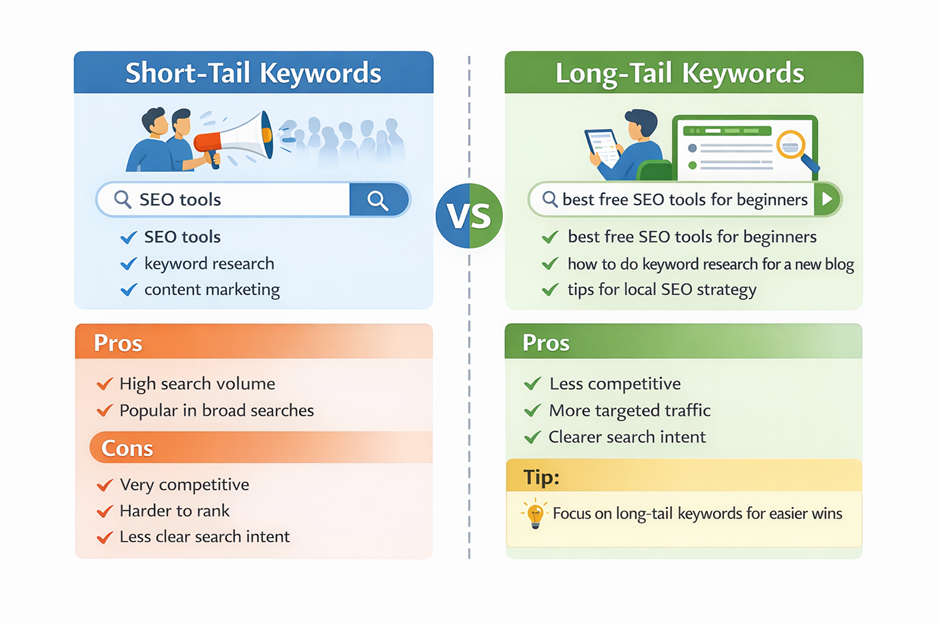
Before you start using tools to find keywords, it’s important to understand the different types of keywords that exist. Not all keywords are created equal — some are short and broad, others are long and specific, and some are phrased as questions. Knowing the formats helps you decide which keywords to target and how to structure your content which leads into answering “what tools are best for conducting keyword research for AEO?”
Short-Tail vs Long-Tail Keywords
In simple terms Short-tail keywords are short, general phrases while Long-tail keywords are longer, more specific phrases.
Tip: For beginners, long-tail keywords are usually easier wins and help your content rank faster.
Question-Based Keywords
Many people search in the form of a question. These often start with who, what, when, where, why, or how.
Examples:
- “How do I do keyword research for SEO?”
- “What is AEO in search?”
Why they matter:
- Perfect for featured snippets
- Aligns with AI answer engines like ChatGPT or Claude
- Makes your content more likely to appear in voice search
Tip: Collect question-based keywords and answer them in your content. This is AEO gold.
Conversational & Voice-Search Queries
With voice assistants like Siri, Alexa, and Google Assistant, people are increasingly speaking their queries instead of typing them.
These queries are usually:
- Longer than typed queries
- More natural and conversational
- Often question-based
Example:
- Typed: “SEO keyword tools”
- Spoken: “Which are the best keyword research tools for SEO beginners?”
Optimizing for conversational queries means your content matches the way people actually speak, which helps with AI-driven search results.
Informational, Transactional, and Navigational Keywords
Keywords can also be classified by intent:
- Informational – The user wants to learn something
- “What is keyword research?”
- “SEO tips for beginners”
- Transactional – The user is ready to buy or take action
- “Best SEO tool subscription”
- “Buy Ahrefs plan”
- Navigational – The user wants a specific site or brand
- “Semrush login”
- “Moz keyword explorer”
Tip: Understanding intent helps you create content that fits the user’s goal. For AEO, informational queries are especially important because AI often answers questions directly.
Keywords for Featured Snippets & AI Answers
Featured snippets (those boxed answers at the top of Google) and AI-generated answers often come from:
- Questions
- Concise, clear answers
- Lists or step-by-step instructions
Examples:
- “How to do keyword research in 5 steps”
- “Top 10 free SEO tools for beginners”
Ultimately, knowing what tools are best for conducting keyword research for AEO? Will empower your content strategy.
Tip: Structure your content to answer questions quickly and clearly. Use headings, bullet points, and numbered lists. This not only helps users, but search engines and AI tools like Claude or ChatGPT can easily pull your content as an answer.
Key Takeaways
- Short-tail vs long-tail: Long-tail is beginner-friendly, short-tail is competitive.
- Question-based: Aligns with AEO and voice search.
- Conversational: Matches how people naturally ask questions.
- Intent matters: Informational, transactional, navigational — target the right one.
- Format for AI & snippets: Clear answers, structured content, and step-by-step lists work best.
Understanding keyword formats is the foundation. Once you know the types of keywords that exist, the next step is to collect them using tools and frameworks, which is where Claude and the APTK framework come in.
3. Set Up a Claude Project with the APTK Framework
Once you understand the types of keywords you need, the next step is to organize your research in a way that’s systematic and actionable. One of the most powerful ways to do this is by using Claude (an AI assistant similar to ChatGPT) together with the APTK framework.
This section will walk you through everything from what the framework is, to setting up a project, to extracting usable keyword insights.
What is the APTK Framework?
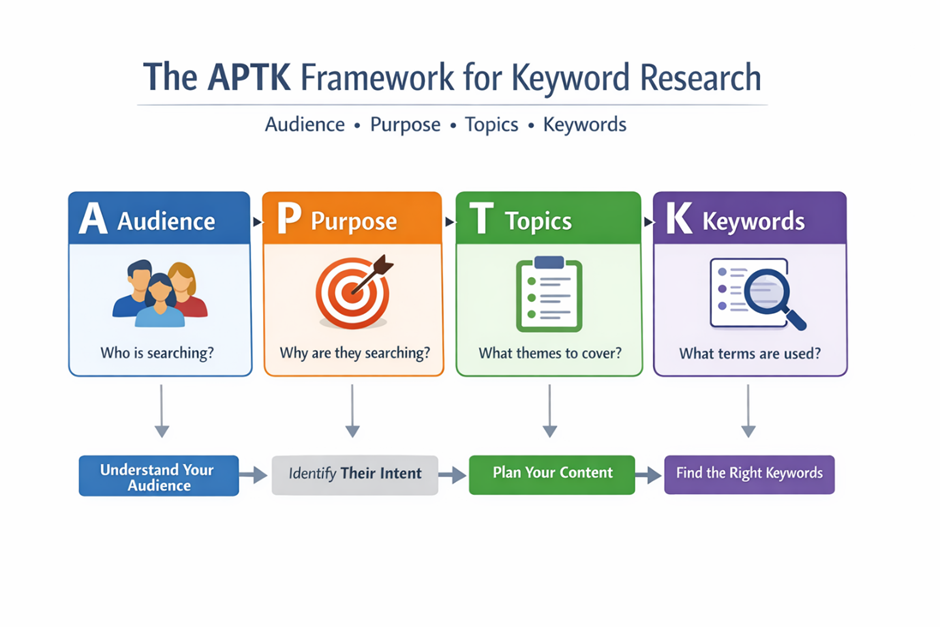
The APTK framework is a simple, structured approach to keyword research and content planning. It helps you make sense of large amounts of data from search engines and AI tools.
APTK stands for:
A – Audience: Who is searching for this information?
P – Purpose: Why are they searching? What do they want to accomplish?
T – Topics: What are the main topics or themes you need to cover?
K – Keywords: What are the specific keywords, questions, or queries people are using?
Think of it as a map for your keyword research:
Audience → Understand your user
Purpose → Understand their intent
Topics → Identify main content areas
Keywords → Gather the actual search terms
This framework ensures your research isn’t random — it’s structured and goal-oriented.
Why Claude Works Well for Structured Research
Claude is an AI tool similar to ChatGPT, but it’s designed for long-form thinking, multi-step reasoning, and project organization. This makes it ideal for:
- Sorting large lists of keywords
- Identifying search intent
- Clustering related queries into topics
- Generating keyword expansions and suggestions
Unlike simple search tools, Claude can process multiple inputs at once and return organized outputs. This is perfect for beginners because it helps you stay structured without feeling overwhelmed.
Step-by-Step Claude Project Setup
Here’s how to set up a Claude project for APTK keyword research:
Step 1: Create a New Project
- Log into Claude (or your preferred AI assistant)
- Click “New Project” or equivalent
- Name it something like: “SEO & AEO Keyword Research – [Your Topic]”
Step 2: Define Your Audience (A)
- Ask Claude to help identify the audience:
Example prompt: - List the main types of users who would search for [topic]. Include their goals and pain points.
Step 3: Clarify Purpose (P)
- Determine the intent behind searches:
Example prompt: - For each audience type, explain why they might search for [topic]. What are they hoping to achieve?
Step 4: Identify Topics (T)
- Group related queries into main topics:
Example prompt: - Based on the search intents above, suggest 5–10 main topics to cover in content. Organize by audience and purpose.
Step 5: Extract Keywords (K)
- Gather actual keywords and questions:
Example prompt: - For each topic, list 20+ relevant keywords and search queries. Include short-tail, long-tail, and question-based keywords.
Example Prompts You Can Use
To make this actionable, here are sample prompts for Claude:
Audience-focused:
- Who searches for “keyword research tools”? List beginner, intermediate, and advanced users with goals.
- Purpose-focused:
- Explain why each user type searches for “keyword research tools” and what problems they want to solve.
Topic-focused:
- Cluster these searches into 5 main topics with clear headings.
- Keyword-focused:
- Expand each topic into a list of 20+ relevant keywords, including long-tail and question-based keywords.
How to Extract Keyword Themes, Intents, and Entities
Once Claude returns its output, you’ll typically get long lists of keywords and questions. Here’s how to organize them:
- Keyword Themes
Group similar keywords under a single theme or topic
Example:
Theme: “Keyword Research Tools”
Keywords: “best free SEO tools,” “keyword research tools for beginners,” “Ahrefs alternatives”
- Search Intents
Label keywords based on intent: informational, transactional, navigational
Helps you decide what type of content to create
Entities
Identify people, brands, or tools mentioned frequently
Example: “Google Keyword Planner,” “SEMrush,” “ChatGPT”
Useful for linking, comparisons, and AI-focused content
Organize in a Spreadsheet
- Columns: Theme | Keyword | Intent | Entity | Notes
This becomes your master keyword map for content creation
Key Takeaways
- The APTK framework organizes keyword research into Audience, Purpose, Topics, and Keywords.
- Claude helps process and structure large keyword datasets.
- Step-by-step project setup ensures beginners can collect meaningful keywords without feeling overwhelmed.
- Organizing keywords by themes, intents, and entities helps you plan content for both SEO and AEO.
- We are now one step closer to answering what tools are best for conducting keyword research for AEO?
4. Use Google, Bing, and Perplexity Autocomplete to Find Keywords
Once you understand keyword types and have structured your research using the APTK framework, the next step is discovering real user queries.
One of the simplest — and most powerful — ways to do this is by using autocomplete suggestions from search engines and AI tools.
Autocomplete shows what people are actually typing, giving you direct insight into real user intent, which is essential for knowing what tools are best for conducting keyword research for AEO?
Why Autocomplete Works for Keyword Discovery
When you start typing a search query into Google, Bing, or Perplexity, the platform instantly suggests completions.
These suggestions are based on:
- Popular searches by real users
- Recent trends
- Location and contextual signals
In other words, autocomplete is a shortcut to understanding what users are actively searching for right now.
Benefits of using autocomplete:
- Reveals long-tail queries and real questions
- Highlights natural, conversational language
- Surfaces variations you might not think of on your own
Tip: For AEO, autocomplete is especially powerful because it mirrors how people ask questions — exactly what AI answer engines prioritize.
Differences Between Google, Bing, and Perplexity
Although all three provide autocomplete suggestions, each has a slightly different strength.
- Largest search engine with the most comprehensive data
- Great for broad research and trending queries
- Offers “People Also Ask” and related searches
Bing
- Often surfaces different phrasing than Google
- Useful for discovering alternative wording
- Integrates AI-driven suggestions via Microsoft Edge
Perplexity
- AI-driven search assistant
- Strong focus on questions and natural language
- Excellent for identifying AEO-focused queries
Tip: Use all three together —
Google for volume, Bing for phrasing diversity, and Perplexity for AI intent alignment.
How to Manually Expand Autocomplete Queries
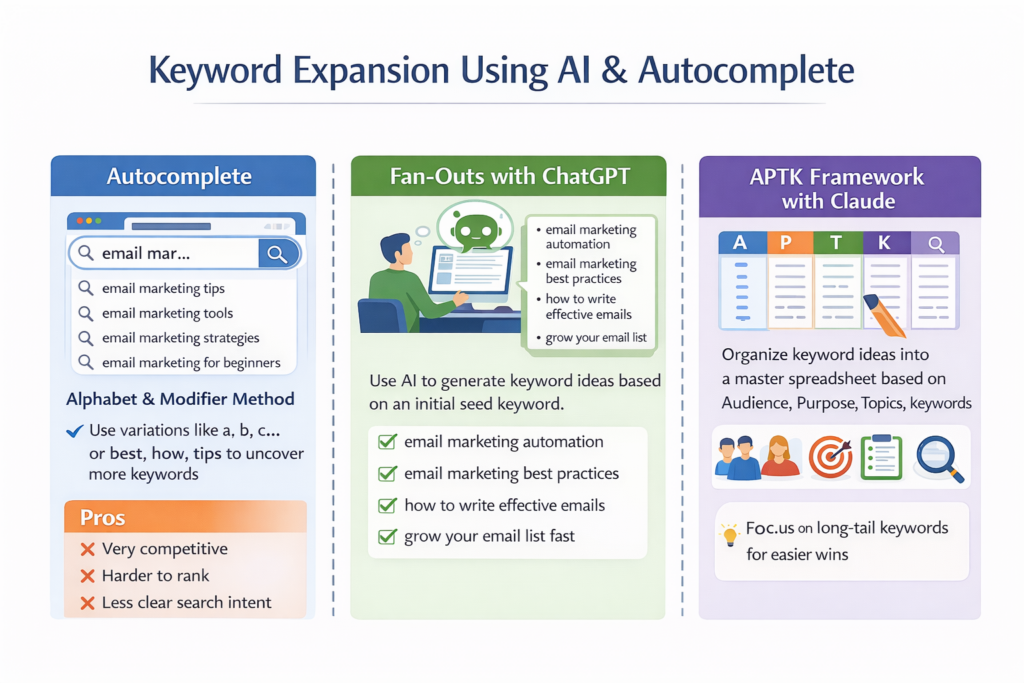
Start with a base keyword, then expand it manually:
- Type your main keyword into the search bar
- Observe autocomplete suggestions
- Note questions, modifiers, and variations
Example
Base keyword: keyword research
Autocomplete suggestions might include:
- “keyword research tools for beginners”
- “keyword research tips 2026”
- “keyword research for blog posts”
These are ready-made long-tail and question-based keywords. Write them down.
Alphabet and Modifier Methods
To expand autocomplete results further, use these two proven techniques.
Alphabet Method
Type your keyword followed by each letter of the alphabet.
Example:
- “keyword research a”
- “keyword research b”
- …
- “keyword research z”
Each letter triggers new suggestions, revealing unique query variations.
Modifier Method
Add common modifiers to your base keyword, such as:
- best
- top
- free
- how to
- for beginners
Example:
- “best keyword research tools”
- “keyword research for SEO beginners”
These methods uncover queries you’d never think to type manually.
Saving and Organizing Autocomplete Keywords
Finding keywords in relation to what tools are best for conducting keyword research for AEO? is only useful if you organize them properly.
Simple Spreadsheet Workflow
Recommended columns:
- Keyword
- Source (Google / Bing / Perplexity)
- Type (Short-tail, Long-tail, Question)
- Intent (Informational, Transactional, Navigational)
- Notes
Collecting Suggestions
- Copy/paste manually
- Or use tools like Keyword Surfer, Ubersuggest, or Ahrefs free suggestions
Cluster and Filter
- Group keywords by topic or intent
- Highlight high-value queries (especially questions and long-tails)
Map to the APTK Framework
- Assign keywords to your Topics (T) and Keywords (K)
- This keeps your research structured and actionable
Tip: Autocomplete changes frequently. Revisit and update your list — especially for trending or seasonal topics.
Key Takeaways (Autocomplete)
- Autocomplete is a free, beginner-friendly way to discover real user intent
- Google offers broad data, Bing reveals alternative phrasing, Perplexity highlights AI-focused queries
- Alphabet and modifier methods dramatically expand keyword ideas
- Organizing keywords makes them usable for content creation
- Autocomplete is especially valuable for AEO, as it reflects natural language searches
5. Look at ChatGPT Query Fan-Outs
After collecting autocomplete keywords, the next step is expanding your research using AI — specifically ChatGPT.
One of the most powerful techniques here is called query fan-outs.
Query fan-outs help you generate a wide range of related queries, long-tail keywords, and questions — making them especially effective for AEO-focused content and aiding in the quest of finding what tools are best for conducting keyword research for AEO?
What Are Query Fan-Outs?
A query fan-out starts with one keyword and expands outward into related searches.
Think of it like a tree:
- The base keyword is the trunk
- Related queries form the branches
- Variations and follow-ups become sub-branches
Example
Base keyword: keyword research tools
Fan-out results might include:
- “Best free keyword research tools for beginners”
- “How to use keyword research tools for SEO”
- “Keyword research tools vs manual brainstorming”
- “Top AI tools for keyword research in 2026”
This gives you a rich pool of keywords and questions to build content around.
How ChatGPT Understands Search Intent
ChatGPT doesn’t just generate random phrases — it recognizes intent.
It can distinguish between:
- Informational: “What is keyword research?”
- Transactional: “Best paid keyword research tools”
- Navigational: “Ahrefs keyword explorer login”
This makes fan-outs especially valuable for AEO, where matching intent matters more than raw volume.
Prompt Examples for Query Fan-Outs
Use clear prompts to get better outputs.
Basic Fan-Out Prompt
Generate 20 search queries related to “keyword research tools,” including questions and long-tail variations.
Intent-Focused Prompt
For “keyword research tools,” generate 15 informational, 10 transactional, and 5 navigational queries.
FAQ Expansion Prompt
Provide 10 FAQs about “keyword research tools” and include variations for each.
Tip: Always request questions and variations, not just keywords.
Turning Fan-Outs Into Keyword Clusters
Once ChatGPT returns results:
Group by Theme
Example:
- Free tools
- How-to guides
- Comparisons
Label by Intent
Informational, transactional, or navigational.
Remove Overlaps
Merge duplicates and near-duplicates.
Map to APTK Topics
Assign clusters to your Topics (T) and Keywords (K).
This turns raw ideas into a usable keyword map.
Using Fan-Outs for FAQ and AEO Content
Fan-outs are ideal for:
- FAQ sections
- Featured snippets
- AI-generated answers
Example
Fan-out question:
“How do I find free keyword research tools?”
Turn it into:
- An FAQ heading
- A concise, structured answer
- A list with tools, pros, and cons
This improves clarity for users and increases visibility in AI-powered search.
Key Takeaways (Fan-Outs)
- Query fan-outs rapidly expand keyword ideas
- ChatGPT understands search intent
- Clear prompts produce higher-quality results
- Clustering turns fan-outs into strategy
- Fan-outs are perfect for FAQs and AEO content
6. Go Creative Mode and Use Filters in Ahrefs or Semrush (Optional)
By now, you’ve collected keywords from autocomplete, structured them using the APTK framework, and expanded them with ChatGPT fan-outs. For many beginners, that’s enough to start creating strong SEO and AEO content.
However, if you want to level up your research, paid tools like Ahrefs and Semrush can help you dig deeper, filter smarter, and validate your findings. This section shows you how to do that without getting lost in complex menus.
When Paid Tools Make Sense
Paid tools are especially helpful when you need:
- Large-scale keyword research across multiple topics
- Insights into keyword difficulty (KD) and competition
- Accurate search volume estimates
- SERP features and trends
- Backlink analysis for competitive research
If you’re a beginner on a small blog, free tools might be enough. But for businesses, growing sites, or content creators targeting competitive niches, Ahrefs or Semrush can save hours of work.
Creative Filtering Strategies
Both Ahrefs and Semrush allow you to filter keywords creatively. Here’s what you can do:
- Search by Keyword Difficulty (KD)
- Filter out high-competition keywords if you’re a beginner
- Focus on medium to low KD for faster wins
- Filter by Search Volume
- Avoid ultra-low-volume keywords unless they are very specific (long-tail or niche)
- Use moderate-volume queries for balanced traffic potential
- Use SERP Features
- Look for featured snippets, People Also Ask, and Q&A boxes
- Target queries that already trigger these features — perfect for AEO
- Combine Filters
- Example:
- KD < 30
- Search volume > 50
- Triggering featured snippet
- This quickly identifies high-opportunity, low-competition keywords
- Example:
Finding Low-Competition AEO Keywords
AI and autocomplete research often produce long-tail, question-based keywords. Paid tools can validate and expand these:
- Paste your AI-discovered queries into Ahrefs or Semrush
- Check KD, volume, and SERP features
- Remove overly competitive queries
- Highlight questions that can be answered directly in content
Example:
- AI suggestion: “How to do keyword research for small blogs”
- Ahrefs KD: 22, volume: 150, SERP feature: Featured snippet
- ✅ Ideal target for AEO-friendly content
Validating AI-Discovered Keywords
One risk of AI-generated keywords is that they may not reflect real search volume or competition. Paid tools help confirm:
- Are people actually searching for these queries? (Check search volume)
- Can you realistically rank for them? (Check KD)
- Are there featured snippets or People Also Ask opportunities? (Check SERP features)
This ensures your AI-driven research is practical, realistic, and actionable, not just theoretical.
Key Takeaways
- Paid tools like Ahrefs and Semrush are optional but powerful for large-scale or competitive keyword research.
- Use filters for KD, search volume, and SERP features to prioritize high-opportunity keywords.
- Paid tools help you validate AI-generated keywords, ensuring your efforts translate into real traffic.
- Target low-competition, question-based queries for AEO-friendly content.
- Creative filtering turns overwhelming data into actionable keyword clusters ready for content planning.
This optional step is the bridge between AI-driven research and real-world SEO performance, helping you focus on keywords that have both search demand and achievable competition.This answers our question on what tools are best for conducting keyword research for AEO?
Conclusion: Mastering Keyword Research for SEO and AEO
Keyword research might seem overwhelming at first, especially with all the tools, frameworks, and AI options available today. But as you’ve seen in this guide, it doesn’t have to be complicated. By breaking the process down into steps, you can approach it systematically and confidently, whether you’re a beginner or a small business owner.
Here’s what you’ve learned:
- Understand the Basics – SEO helps your content rank in search engines, while AEO ensures your answers are clear, structured, and ready for AI-driven responses. Both work together to reach your audience effectively.
- Know Keyword Formats – Short-tail, long-tail, question-based, and conversational keywords all serve different purposes. Recognizing them helps you target the right queries for the right intent.
- Use Frameworks Like APTK with Claude – Structuring your research around Audience, Purpose, Topics, and Keywords makes the process manageable, even when dealing with hundreds of queries.
- Leverage Autocomplete – Google, Bing, and Perplexity autocomplete reveal real user queries, helping you capture natural language and long-tail searches for both SEO and AEO.
- Expand with ChatGPT Fan-Outs – AI can generate dozens of related queries from a single keyword, uncovering question-based content opportunities that your readers are actively looking for.
- Optional Paid Tool Filtering – Ahrefs or Semrush can validate AI-generated keywords, uncover low-competition opportunities, and refine your strategy for maximum impact.
By combining these methods, you’ll have a robust, structured list of keywords ready to guide your content creation — from blog posts and FAQ pages to AI-optimized answers.
Key Advice for Beginners: Start small. You don’t need to master every tool or technique at once. Begin with autocomplete and fan-outs, organize your keywords using the APTK framework, and gradually explore paid tools as your confidence grows.
Keyword research is no longer just about ranking pages — it’s about understanding what your audience wants, how they ask questions, and how your content can be the best possible answer.
Once you’ve mastered this process, every blog, landing page, or FAQ you create will be strategically aligned to both human readers and AI-powered search engines, giving your content the best chance to succeed.
So grab your keywords, organize your clusters, and start creating content that answers questions, solves problems, and stands out — because great keyword research is the foundation of great content.
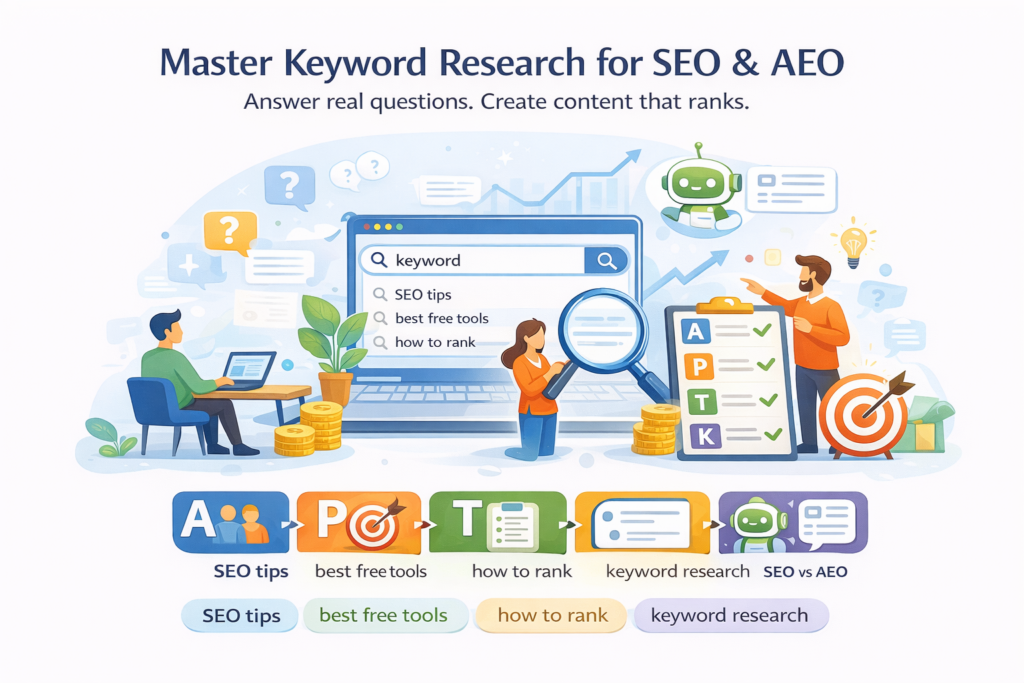
In conclusion, you will find that what tools are best for conducting keyword research for AEO? Is paramount for any digital marketing strategy.